Conflicting Testimony and the Uncertainty of Truth
The Book of MirrorsConflicting Testimony and the Uncertainty of Truth describes the central epistemic problem surrounding Joseph Wieder’s killing: the people whose accounts might clarify the crime disagree about the evening’s sequence, while none of their statements can be treated as self-validating. Derek Simmons identifies Richard Flynn as the killer and Laura Baines as an eyewitness or accomplice; Frank Spoel’s confession places Richard at the house but excludes Laura; Sarah Harper admits that she gave Laura an alibi she knew was false; and Laura denies visiting the house that evening. Later disclosures make the earlier police record look less complete, but they do not resolve every contradiction. The investigation turns on the difference between a plausible reconstruction and a fact that can be independently established.
The Accounts and Their Disagreements
In his account to Roy Freeman, Derek Simmons describes events on 21 December 1987 from the perspective of someone who says he was near Joseph Wieder’s house at crucial moments. Earlier that day, he had gone there to repair the downstairs bathroom toilet. Over lunch, Joseph Wieder spoke about snow-marks in the backyard that suggested someone had been there, said he was preparing to travel to the Midwest for the holidays, and urged Derek Simmons to keep taking his medication. Derek Simmons says he returned that night because he was worried about him. He saw Laura Baines’s car nearby and heard an argument inside before entering the backyard.
Derek Simmons says he saw Richard Flynn leave, but suspected that he had run off and hidden close by. After looking in on Joseph Wieder, who was alive and opening a window, Derek Simmons left because he feared being seen. He says Laura Baines’s car was back in roughly the same place as he departed, and he assumed she had returned to spend the night with Joseph Wieder. The next morning, using his own keys after nobody answered the door, he found Joseph Wieder’s body in the living room. From these observations he concluded that Richard Flynn had hidden nearby and returned to kill him, while Laura Baines had either helped or witnessed the crime. Crucially, Derek Simmons acknowledged that he had not told police about Laura Baines, explaining that he feared publicity would tarnish Joseph Wieder’s name; he had instead told them that Richard Flynn had been present and argued with Joseph Wieder.
Frank Spoel’s later account agrees on one important point but diverges sharply on the rest. He says that he reached the house at around nine in the evening and saw only Joseph Wieder and Richard Flynn. Richard Flynn remained until around eleven, after which Frank Spoel waited before entering through an open window and hiding in the corridor. Frank Spoel then describes attacking Joseph Wieder from behind with a baseball bat, striking him repeatedly after he got up, and fleeing through the glass door when someone opened the front door. He says he left the bat in a partly frozen stream and spent the night in a woodshed near Assunpink Creek. In his version, Laura Baines was not there, and Joseph Wieder was alone after Richard Flynn left.
These narratives cannot simply be combined into one seamless chronology. Derek Simmons places himself outside the house at the same time Frank Spoel says he was hiding in the backyard, yet neither says he saw the other. Derek Simmons reports an argument involving Richard Flynn and Joseph Wieder, and says Laura Baines left before her car appeared again; Frank Spoel recalls no disagreement and no woman. The accounts also differ over who entered the house, what that person could have seen, and whether Laura Baines arrived before or after the attack. The gaps are not incidental: they affect whether the crime appears to have had one assailant, a possible accomplice, or a later visitor who encountered an injured man.
Records, Alibis, and Retrospective Revisions
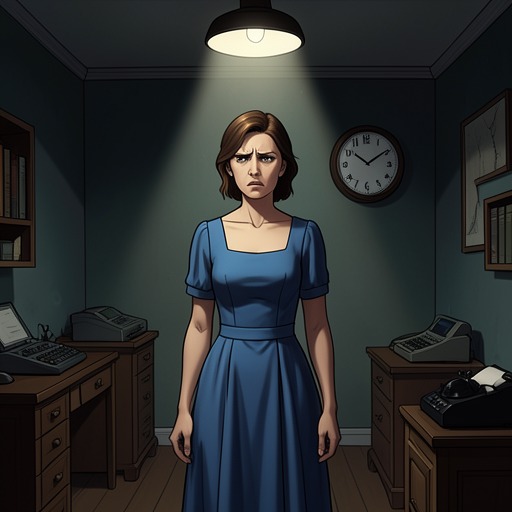
The police record initially made Laura Baines far less visible than the later accounts do. Her name appeared in a general account of Joseph Wieder’s acquaintances, not as a named suspect or witness, and she was questioned only once. Investigators had some suspicion that she might have been at the house that evening, but both she and Richard Flynn denied it. Richard Flynn said he had been drinking with Joseph Wieder and that Laura Baines was not there. He was interviewed three times, answered clearly, and passed a polygraph test. The detective later recalled that Laura Baines had a strong alibi, reportedly confirmed by a schoolmate, and treated that as a reason she could not have been at the scene.
Sarah Harper’s later disclosure undermines that apparent alibi. She says Laura Baines arrived at her home early in the morning, frightened after an argument with Richard Flynn, and asked her to say they had spent the entire evening together. Sarah Harper agreed, believing at first that the request concerned Richard Flynn. She recalls that Laura Baines had collected her belongings and had them in the trunk of her car, and that Timothy Sanders had recently returned and planned to move in with her again. Sarah Harper lived in Rocky Hill, about five miles from campus; she estimated that the journey from the house Laura Baines shared with Richard Flynn would take about twenty minutes, even in bad weather.
The timing Sarah Harper supplies makes the earlier version harder to sustain. In Roy Freeman’s reconstruction, Laura Baines could have driven from Joseph Wieder’s house in West Windsor to Richard Flynn’s home in about half an hour, spent another hour packing, and then continued to Sarah Harper’s. If she had returned to Joseph Wieder’s house after leaving Richard Flynn’s home, she may have left around one in the morning, not at nine in the evening as Richard Flynn told police. Sarah Harper says she sensed that Laura Baines was lying but was tired, no longer wanted the friendship, and did not press her for details. Laura Baines had left by seven in the morning. When Sarah Harper heard the news on the radio the next day, she stopped on the Jersey Turnpike, got out of the car, and vomited. Despite her suspicions, she later told police that Laura Baines had been with her from lunchtime until the next morning; she says she did so because Laura Baines dominated her and she felt unable to refuse.
Credibility, Memory, and Institutional Judgment
The investigation also shows how a witness’s perceived credibility can shape which evidence is heard. Derek Simmons says he had told authorities what he knew at the time, but expected his statement to be dismissed because he had previously been accused of murder, confined in a psychiatric institution, and given medication. He insists that these circumstances did not mean he was inventing what he had seen. Years later, however, a police detective remembers Derek Simmons as ill, amnesiac, and mentally unreliable, and says there was little that could be done with his statement. When Roy Freeman questions the detective about Laura Baines’s possible presence, the detective similarly emphasizes the strength of her alibi and the lack of proof that she and Joseph Wieder were lovers.
Derek Simmons’s presentation does not settle the question of reliability. During an interview, he chain-smokes while recounting details that surprise Roy Freeman with their clarity. In another investigative encounter, the detective suddenly stops speaking, takes a prescription bottle from his pocket, and swallows a green pill before resuming; his own difficulty recalling the case sits beside his confidence that Derek Simmons’s account was unusable. These details do not prove that either man is wrong. They expose how memory, illness, and the act of remembering become part of the evidence, rather than neutral conditions outside it.
Frank Spoel’s account is also subject to a direct challenge: Roy Freeman points out that his description conflicts with Derek Simmons’s earlier statement and later retelling. Derek Simmons dismisses the mismatch by suggesting Frank Spoel may have forgotten or may be lying, and asks why his own account should be trusted less. The exchange reveals the investigation’s basic impasse. A confession can be detailed without answering every question about who else was present; an eyewitness account can be confident while containing omissions; and a police file can preserve a mistaken alibi as if it closed a line of inquiry. The narrative gives no simple rule by which confidence, detail, or official status automatically guarantees truth.
Competing Reconstructions and Their Limits
Roy Freeman’s earlier investigator, John Keller, had developed a theory in which Laura Baines and Richard Flynn acted together. Keller suspected that Laura Baines had been in the house and stolen Joseph Wieder’s recently completed manuscript, which he was about to send to his publisher. He thought Richard Flynn had probably wielded the bat, while Laura Baines had been the intellectual instigator and the person with the most to gain. That theory drew force from Laura Baines’s possible motive and the apparent benefit she might have obtained, but it remained a reconstruction rather than a proven account.
Frank Spoel’s testimony opens a different possibility. If he attacked Joseph Wieder but left him alive and fled when someone entered, a later visitor with a key could have found him unconscious, failed to call for help, and taken the manuscript. Roy Freeman reasons that an opportunistic visitor might have left by closing the glass door through which Frank Spoel escaped and locking the entrance behind her; Derek Simmons had said that the doors and windows were closed when he found Joseph Wieder in the morning. This scenario could explain how Laura Baines might have stolen the manuscript without being Frank Spoel’s accomplice or Richard Flynn’s partner in the assault. It also depends on Frank Spoel’s account being accurate about the timing and Joseph Wieder’s condition, which the conflicting testimony prevents the investigation from treating as certain.
Laura Baines rejects the claim that she went to Joseph Wieder’s house that evening and says she had not visited him for weeks. When Roy Freeman confronts her with Sarah Harper’s false alibi, Laura Baines acknowledges asking for it. She explains that she wanted to avoid newspapers and insinuations about her relationship with Joseph Wieder, not to evade a murder accusation. Her explanation is consistent with a fear of scandal but does not erase the lie or establish where she was. She also says Richard Flynn was not with her that afternoon, complicating the account of their movements without independently resolving the evening’s events.
Narrative and Thematic Significance
The competing statements arrive through successive investigations and remembered encounters, so each new account revises the reader’s understanding of what was supposedly settled. The police interviews, Sarah Harper’s retrospective explanation, Derek Simmons’s renewed account, Frank Spoel’s confession, and Laura Baines’s denial do not form a single authoritative record. They create a layered inquiry in which later information reveals omissions in earlier versions, while also introducing fresh uncertainty. In this structure, a revelation can narrow the possible sequence without confirming it.
The result is not that every account is equally persuasive, but that credibility must be tested against circumstances and against other evidence. Derek Simmons’s psychiatric history may explain why investigators discounted him, yet his allegation about Richard Flynn and Laura Baines cannot by itself establish guilt. Sarah Harper’s confession shows that an apparently solid alibi was false, but her account of Laura Baines’s movements still leaves intervals unobserved. Frank Spoel’s confession identifies him as the attacker in his version, but does not explain who entered afterward or what that person did. The uncertainty persists because the witnesses’ statements describe overlapping fragments, not a complete, independently verified sequence.